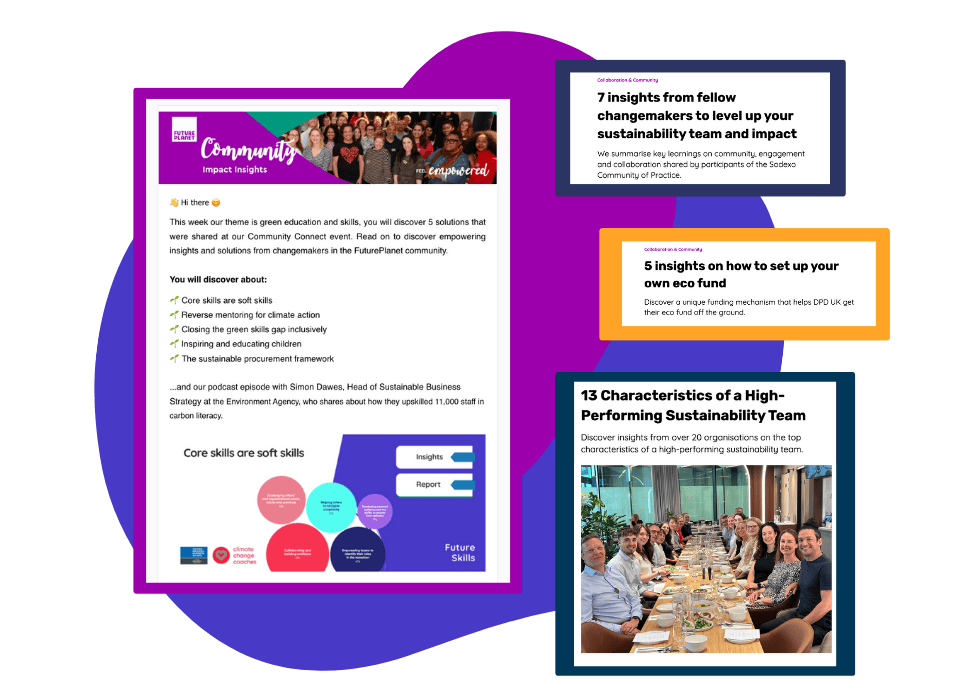
5 stories on AI emissions, climate finance, business case, GHG protocol and circularity, from the FuturePlanet community and network.
5 empowering stories from the FuturePlanet community and network. Read on to discover insights on AI emissions, climate finance, building the business case, GHG protocol, and circularity case study.
To collaborate with fellow changemakers solving challenges and sharing solutions
Apply to join the FuturePlanet community here ⬇
1! A framework for measuring the emissions from your company's AI use
According to a Watershed report, "Electricity demand from data centres is expected to grow from roughly 5% of US consumption in 2025 to between 9% and 17% by 2030. Corporate AI use is following a similar trajectory across employee assistants, direct access to large language models and AI features built into enterprise software. AI emissions are a small share of most company footprints today, but that share is unlikely to remain small for long. Without reasonable estimates, companies cannot set reduction targets or identify effective decarbonisation levers as those emissions grow." Read more for how to measure your own AI emissions, which uses of AI consume the most energy, and the levers available to reduce it. [Read more] →Action: How robust is your organisations governance around AI and energy use.
2! In the US, climate finance is concentrated on energy transition
A trend that is often heard in conversation is the slowing of traction in US companies. But does that really tell the whole picture? Or can we be communicating optimism and intent - and understand where the gaps really are. Global climate finance has nearly doubled over the past decade. In the US, nearly $400 billion of private investment and philanthropic grants reached more than 10,000 companies and nonprofits between 2018 and 2024. One Earth and Vibrant Data Labs have created a tool that shows data behind the funding and where we need to fund. One gap is that energy takes 89% of tracked funding, while nature conservation gets 4% because markets find nature's essential services difficult to monetise. [Explore the tool here] →Invitation: How can we change that?
3! Building the business case is multi-dimensional
In this career perspective piece, FuturePlanet member Emily Hamilton - previously CSO of Savills Investment Management, where she led the integration of sustainability risks and opportunities into investment processes, governance and operations across a global real estate investment business with £22bn of assets under management - sets out the case that the business case is more than just financial and why governance, trust and decision-making matter as much as the Return on Investment. [Read more]
4! Simplifying reporting: GHG Protocol announcement
Simplifying reporting would be a boon to the industry and save precious time we could invest in making progress on our goals. Tim Mohin, CEO of GHG Protocol, said: "A consolidated corporate standard represents a significant step toward integrating and harmonising greenhouse gas accounting across the world. For the organisations applying these standards to measure their greenhouse gas emissions, a single corporate standard will simplify reporting, reduce duplication, and provide greater consistency across markets and jurisdictions. This will in turn allow companies to spend more time reducing emissions.” [Read more]
5! How Google reused 80-year-old structural timber from a hangar
Circular business models are continuing to be experimented with and integrated into core business operations. Structural wood is almost always treated as single-life, moving from harvest to fabrication to disposal, and large-scale reclamation is often dismissed as unpredictable, labour-intensive and economically burdensome. Google reclaimed the wood from a 1943 aircraft hangar, tested, approved and made it available for reuse. As Robert Little shared "If we can successfully harvest eighty-year-old, chemically treated timber and requalify it for modern building codes, why do we still accept total demolition as the default strategy for commercial real estate?" Good point - who and what is next? [Read more]

Have thoughts or story to share? Tag Carl and Gian on LinkedIn.
To collaborate with fellow changemakers solving challenges and sharing solutions. Apply to join the FuturePlanet community here ⬇